For the upcoming 7th May local elections, we held a hustings (jointly with Living Streets and Low Traffic Hackney) for Mayoral candidates on the 16th April.
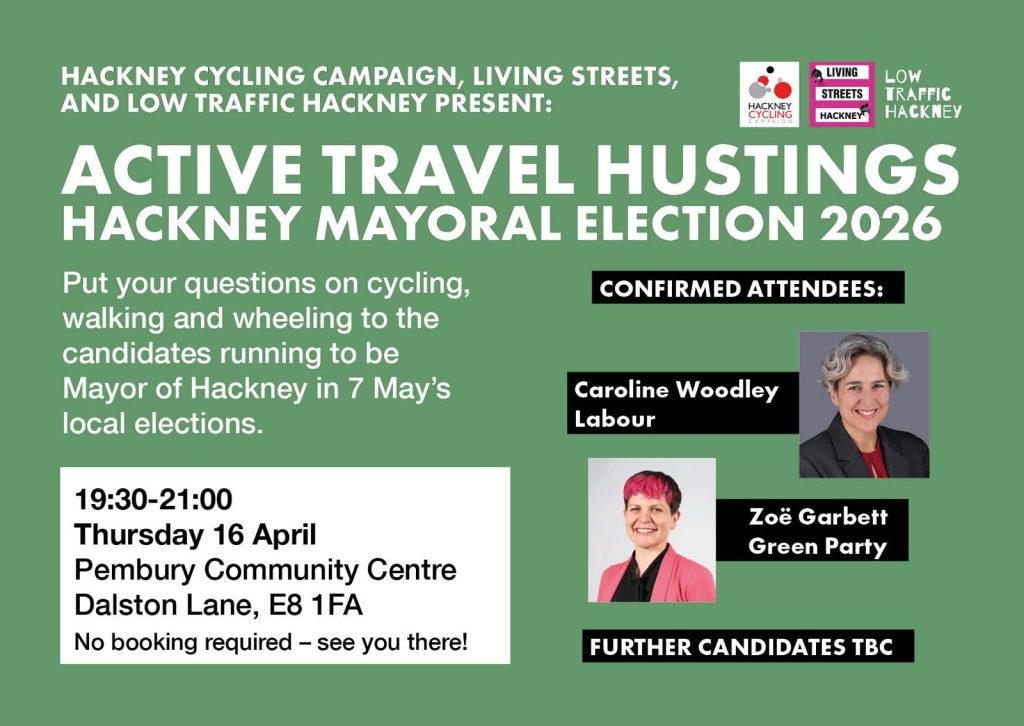
Three candidates attended: Zoë Garbett (Greens), Tareke Gregg (Conservatives) and Caroline Woodley (Labour). We heard the candidates share their plans for active travel in the borough, and then the audience put questions directly to them. If you couldn’t attend, please check out our thread on Bluesky of posts we made during the the event.
Here are our asks of the candidates, which were shared with them ahead of the hustings. We’ll include below whether the candidate supported the ask, and any further response from them:
Our asks of the candidates
- Enable all children to safely walk and cycle to every primary and secondary school in Hackney
There should be school streets (which 20,000 students currently benefit from, a little over half), filters, protected cycle lanes on main roads, or safe junctions for every primary and secondary school in Hackney by 2030.
School streets already delivered without enforcement measures should be upgraded.
Zoë Garbett (Greens 🟩): Supported this ask ✅ and sent us this response:
“Our children must be safe to move around and play. Yet people in Hackney are hit by cars at a higher average rate than any other inner London borough. It should be neither inevitable nor acceptable that people are killed and seriously injured on Hackney’s roads. But neither London nor Hackney are currently on track to meet that target.
Earlier this year, I visited Queensbridge School with Save the School Run and heard the sincere concern from parents and teachers and witnessed the need to enforce school streets. We need to take radical steps to end road death and serious injuries, underpinned by an equalities-first approach – this means designing and monitoring our schemes with transparency so that they work for everyone.
We would make school crossings a top priority, starting with the seven primary schools that currently have no safe crossings, and will create traffic-free School Streets for all eligible primary and secondary schools, as well as introducing them at colleges. We would also prioritise protected and fully accessible cycle lanes and networks of low traffic streets and publish an implementation plan for a cycle network that allows all Hackney residents to live within 400m of a high-quality cycle route.”
Tareke Gregg (Conservatives 🟦): Supported this ask ✅
Caroline Woodley (Labour 🟥): Supported this ask ✅ and sent us this response:
“Hackney is a borough where more journeys are made by bike than almost anywhere else in the UK and we share your ambition for cycling to continue to grow here. Every child in Hackney is offered cycle training at primary school and some free adult cycle training schemes are also being delivered. We are committed to every child in Hackney enjoying a safe journey walking, wheeling or cycling to school.
We have 51 school streets, including almost every primary school in Hackney and are expanding school streets for secondary schools and independent schools in the borough. We have allocated capital funding to continue to expand School Streets to every school where they are required, and to install CCTV cameras where they are needed to ensure compliance.
In our emerging Transport Strategy, if re-elected, we want to go further – developing safe areas that reflect the many different journeys children take to school, and looking at where some of our school streets could be upgraded into play streets.
I’ve also really enjoyed seeing the development of “bike buses” in Hackney, and am keen to support schools in accommodating them.”
- Continue to roll out low-traffic neighbourhoods, and connect gateways between them to maximise their potential for safe cycling, walking and wheeling
We wish to see the council accelerate rollout of area-wide traffic reduction schemes, so the benefits can be shared across the whole of the borough.
Existing schemes with time-based restrictions (e.g. Lansdowne Drive, and Chatsworth Road) should be made operational 24/7. Safety measures cannot only be operational just some of the time.
To maximise the benefits of these low traffic areas, gateways should be installed across boundary roads to allow safe cycling, walking and wheeling between them.
Zoë Garbett (Greens 🟩): Supported this ask ✅ and sent us this response:
“We need streets that feel safe and convenient for more people to walk, wheel and cycle, and fully support traffic reduction schemes such as LTNs which have proven that they can keep people safe and help them move around where implemented properly.
In Hackney, many measures have worked brilliantly, including Stoke Newington Church Street and Lea Bridge’s Leagrave and Hillstowe gate. Unfortunately, the implementation of certain Low Traffic Neighbourhoods (LTNs), such as the Chatsworth Road changes, has been rushed by the Labour-led council who have not been clear about their strategy. This risks tensions building, not because residents don’t want safer streets, but because this is a particularly sensitive location with the river, hospital, and busy roads nearby. TNs with connected gateways can and should work well, and we are determined to make them a success here in Hackney.”
Tareke Gregg (Conservatives 🟦): Did not support this ask ❌
Caroline Woodley (Labour 🟥): Supported this ask ✅ and sent us this response:
“We know that our network of low traffic and liveable neighbourhoods is integral to making our streets safer, improving air quality, making our streets greener and more resilient in the face of climate change, and also helping to support more people to use active travel, improving public health. Over 70% of our streets are in low traffic and liveable neighbourhoods.
We recently delivered a liveable neighbourhood around Chatsworth Road and are monitoring it carefully. We are in the midst of delivering liveable neighbourhoods in and around Dalston and are also looking at Hoxton Street. We’re working with TfL, Islington and Haringey to extend C50 as well as making Manor House safer for people walking and using buses. As part of this work, we are tackling Hackney’s most dangerous junctions.
We are looking at joining up low traffic routes through a gateways approach, for example with the recent consultation on the Cassland Road scheme. We would look to build on this in our emerging Transport Strategy if re-elected, joining up low traffic neighbourhoods with networks of cycle and walking routes, updating the position since the last TfL Cycling Analysis and working with partners and neighbouring boroughs to contribute to a cohesive network across our capital city.”
- Reduce use of kerbside space for private car parking by 10% by 2030, and convert to more sustainable uses
The council should adopt a formal strategy for reducing the use of kerbside space for private car parking, and instead use this valuable and limited resource for more sustainable and beneficial uses.
This should include (on every residential street) parking for dockless micromobility vehicles, cycle hangars, and also traditional bike parking. It would also free up space for greening, car club spaces, and could speed up bus services.
Zoë Garbett (Greens 🟩): Supported this ask ✅ and sent us this response:
“We agree that a formal strategy should be adopted by the council. If elected, we would design and implement a Kerbside and Parking Strategy to bring new life to kerbside spaces for safer crossings, greater accessibility, public seating, climate resilience and increased urban biodiversity. This would include cycle hangars, where we are seeking funding to significantly increase provision throughout the Borough“
Tareke Gregg (Conservatives 🟦): Did not support this ask ❌
Caroline Woodley (Labour 🟥): Supported this ask ✅ and sent us this response:
“We’ve made big changes to our use of kerbside space, removing parking for cycle hangars, rain gardens, linear parks and street trees, pocket parks, dockless hire bays, standard cycle parking, car club parking and electric vehicle charging points, while ensuring bays remain where required for loading and for blue badge holders. We are therefore on track to repurpose approximately 10% of parking spaces. Our Kerbside Strategy will be developed as part of our upcoming Transport Strategy, looking at how we can expand and improve upon the work we’ve done.”
- Connect Hackney’s town centres by tackling dangerous roads and junctions
Many of Hackney’s town centres are not currently connected to their neighbouring town centres, either in Hackney or in adjacent boroughs. We ask that the council work towards filling these gaps by 2030, creating new cycleways formed of streets made suitable for cycling through traffic filtering, or the installation of new protected cycle tracks.
TfL regularly produce a strategic analysis of London, identifying missing links in the cycle network. Building the missing Hackney routes shown in their 2023 analysis would achieve much of this ask.
Zoë Garbett (Greens 🟩): Supported this ask ✅ and sent us this response:
“The Hackney Green Party’s traffic policy is rooted in safety and ensuring our streets reflect the hierarchy of transport. We pledge to prioritise protected and fully accessible cycle lanes and networks of low traffic streets by reclaiming streets from cars and publish an implementation plan for a cycle network that allows all Hackney residents to live within 400m of a high-quality cycle route. We will also increase cycle training provision for global majority and disabled residents, through partnerships with schools, charities and local businesses, and seek funding to significantly increase cycle hangar provision throughout the borough.”
Tareke Gregg (Conservatives 🟦): Supported this ask ✅
Caroline Woodley (Labour 🟥): Supported this ask ✅ and sent us this response:
“Work is in progress to transform Hackney Central, including making one of our worst junctions, Pembury Circus, safer, especially for pedestrians and cyclists. We have more to do and we’re also pressing TFL on road safety at their junctions, such as Kenworthy Road, Hackney Wick and Stoke Newington, while working with neighbouring boroughs to achieve a cohesive London network. “
- Reduce overall motor traffic volumes, and explore piloting a road pricing scheme in Hackney
Too often roads and junctions in Hackney are optimised for maximum throughput of motor vehicles, leaving pedestrians and cyclists marginalised. There seems to be a reluctance to rebalance this, with impacts to essential services (such as buses) from congestion often cited as a justification for avoiding change. As such, we want the council to commit to a target for reducing overall motor traffic in the borough, to address the real root cause of congestion.
We also wish for the council to actively explore potential methods for distance-based charging of road users, particularly at times and locations when congestion is at its worst, to target this problem directly.
Zoë Garbett (Greens 🟩): Supported this ask ✅ and sent us this response:
“We want to be ambitious with reducing traffic, and our aim is to achieve a 30% reduction in miles driven on Hackney roads by 2030. We want to make it easier to choose safe, accessible, affordable and space-efficient travel — walking, wheeling, buses, trains, cycling and car clubs — which will reduce congestion and help everyone get where they need to go.
We also recognise that the size of cars on our streets is growing exponentially, and the increased number of SUVs increases collision risk, worsens injuries outcomes and causes additional wear and tear on our roads. What fundamentally separates us from other parties in this election is that we will innovate to transform our borough by adding a new tool – the Road Safety Premium – this will be a form of road pricing for the largest private vehicles entering Hackney. This new tool will not only make our streets safer, but it will reduce chokepoints for buses, cut congestion and send the message to the car industry that we won’t be fatal experiments for their newest toys.
We also plan to introduce subsidies for cargo bikes, support businesses and tradespeople to transition away from vans, and implement clear road markings across the borough that reflect the highway code’s hierarchy of users.”
Tareke Gregg (Conservatives 🟦): Did not support this ask ❌
Caroline Woodley (Labour 🟥): Supported this ask ✅ and sent us this response:
“We are committed to reducing overall motor traffic in Hackney, with a focus on reducing through traffic that is not coming to or from the borough. As part of this, we are already on record with our commitment to exploring road user charging with the Mayor of London, alongside all of the work described here to support and encourage active travel in Hackney, supporting our long-term health and safety and enjoyment of all that our borough has to offer!”